How Calyber turns one workout into the next one.
Calyber writes the session, you log load, reps, and RIR, then the next session updates from what actually happened, so every session keeps driving muscle growth instead of wasted fatigue.
Every number on this page comes from a captured 13-week proof block: 1,068 sets logged across 26 exercises, 34 adjustments, all traceable.
One session, start to finish
Calyber writes the session, you log what happened, and the next session is recalculated from it. Here is the whole loop, on screen.
- PRESCRIBED01
Calyber gives the prescription before you lift
You open the session and the work is already written: which exercise, the target weight and reps, and how that compares to last time.
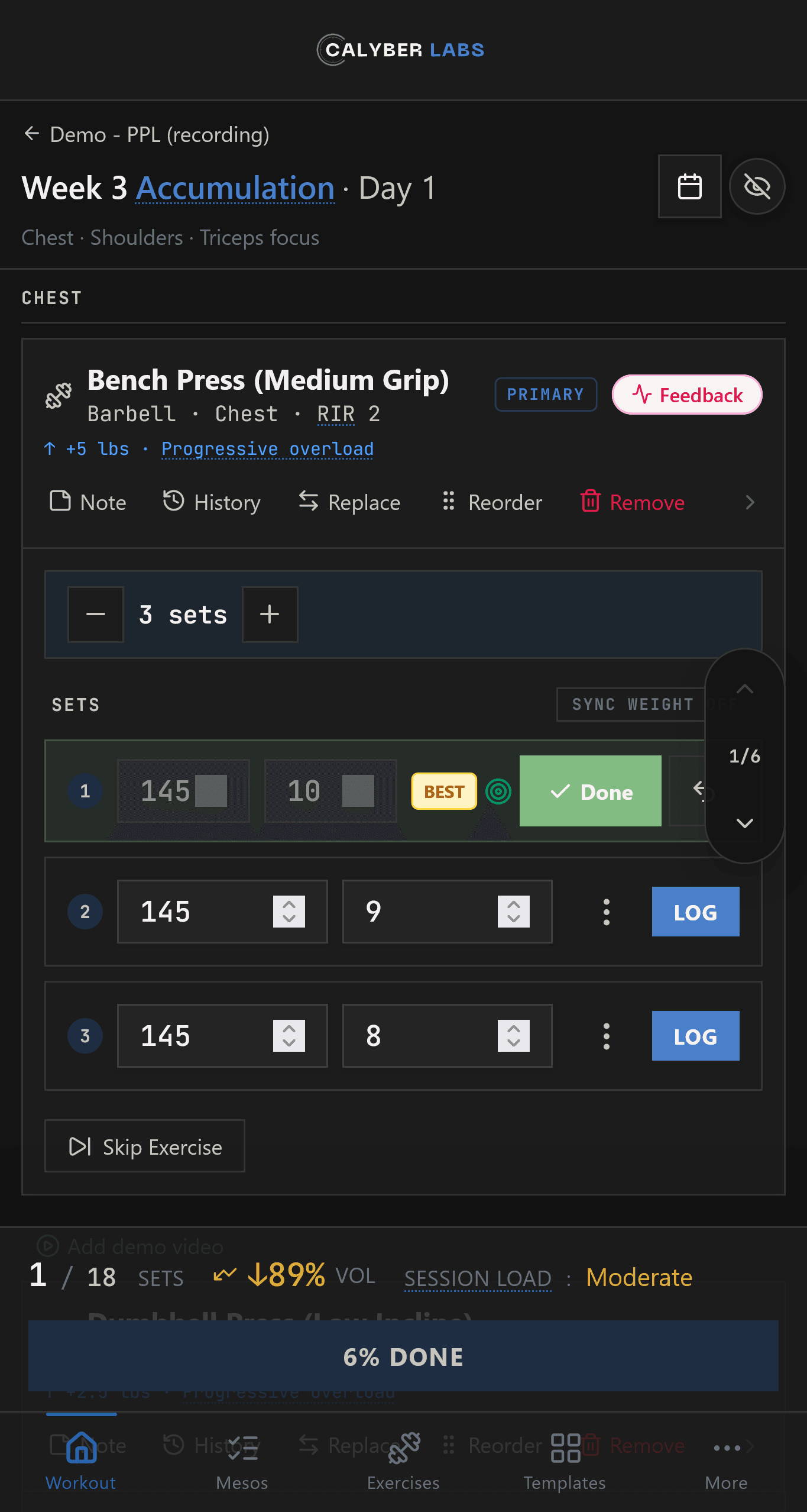
- Decided before you lift
- Load steps up from last log
- Effort capped at RIR
- Decided before you lift
- Load steps up from last log
- Effort capped at RIR
In-app: the prescribed set, before you lift. - LOGGED02
You log load, reps, and RIR
After each set you enter the weight, the reps you completed, and how many you had left in the tank, your RIR. That is the whole input.
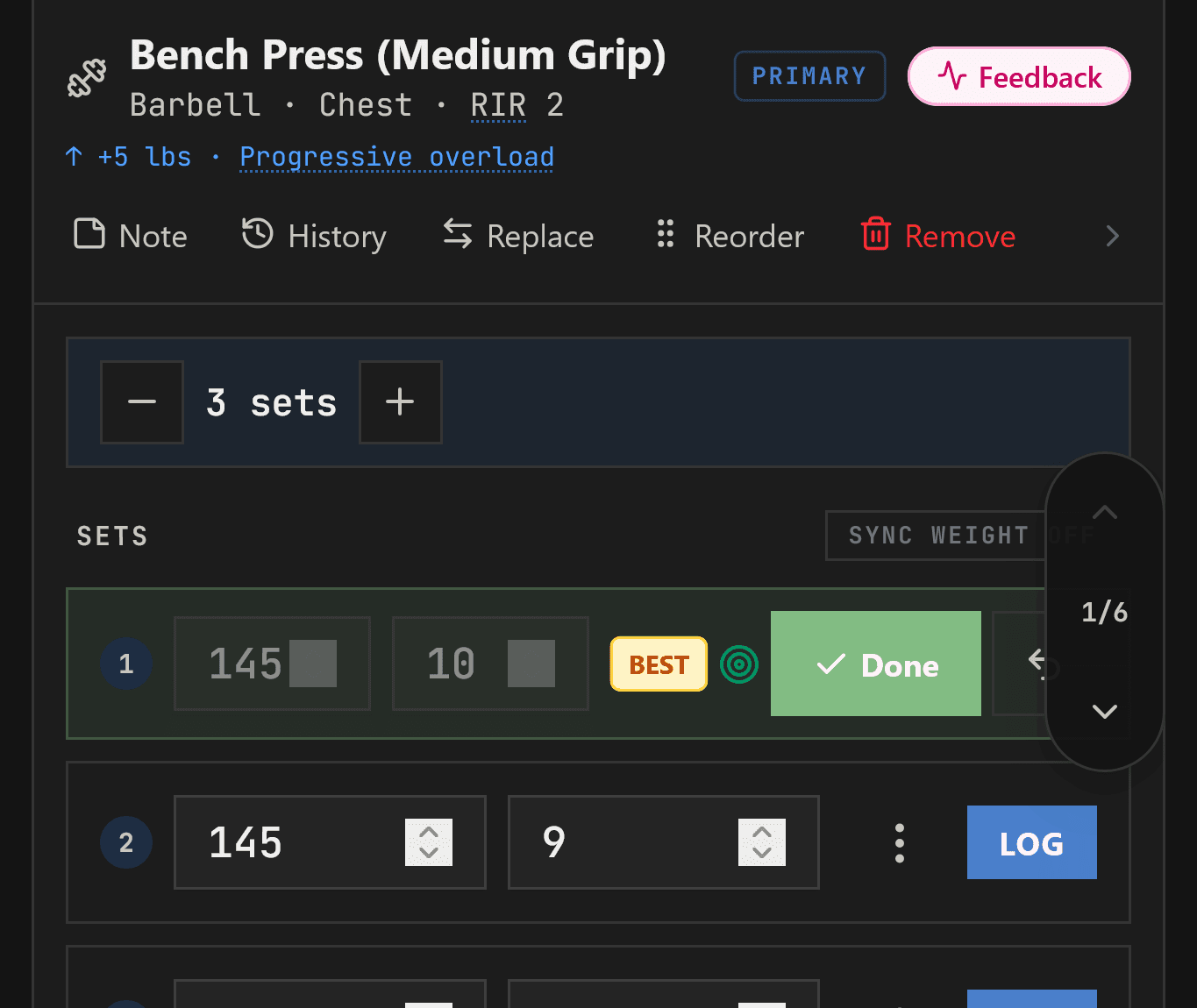
- Load you lifted
- Reps completed
- Effort left, your RIR
- Load you lifted
- Reps completed
- Effort left, your RIR
In-app: logging a set, load, reps, and RIR. - READ03
Calyber reads performance, effort, and fatigue
The logged set feeds the engine. It weighs your output against the target, the effort against your rating, and the load against recovery.
Logged set → engine → next prescription
INPUTBench Press · 145 × 10 · RIR 2READSperformance · effort · fatigueOUTPUT150 × 9 · RIR 1 · +5 lbs - VERDICT04
You get a verdict, not vague feedback
The session closes with a decision, not a pep talk. This is not motivation copy. It is a training decision summary.
SESSION VERDICT- SESSION RESULT
- On plan
- TRAINING LOAD
- Accumulating
- NEXT WEEK
- Overload · +5 lbs
Reconstructed from the proof block - NEXT SESSION05
The next session updates, exercise by exercise
Some lifts progress, some hold, some get watched. Calyber does not change everything at once. Each call traces back to what you logged.
NEXT SESSION+1 added · held · watch- Shoulders+1
- Triceps+1
- ChestHELD
- Biceps-1
- Bench PressWATCH
Reconstructed from the proof block
That loop is the point. Every session feeds the next, so more of the block turns into muscle instead of wasted fatigue.
The same loop, recorded
Sixty seconds of one real set going in and the next prescription coming out. Silent, captions available.
- 01PRESCRIBED
- 02LOGGED
- 03SIGNAL
- 04NEXT SESSION
Static plans repeat. Calyber responds.
A fixed program runs the same script regardless of how your sessions actually go. Calyber reads each session and adjusts the next one.
Same sets and reps every week until the program says otherwise.
Updates from the load, reps, and RIR you logged last session.
A lighter week lands on a fixed calendar date.
A lighter week appears when fatigue accumulates, per muscle.
One rule applies to the whole plan.
Each exercise moves on its own: some push, some hold, some pull back.
Repeats week 1, unchanged.
+5 lbs, sets 3 to 5, from logged performance.
What Calyber reads
From the three numbers you log, the engine tracks six things across the block.
Calyber is not reading one number. It is reading the relationship between output, effort, fatigue, and context.
Whether strength and reps are trending up, flat, or down.
How hard the set was, checked against output, not only your rating.
Whether training demand is outrunning recovery.
Where you are in the plan.
Every prior set logged for this lift.
Whether missed or changed sessions should shift the plan.
Decisions Calyber helps you stop guessing
You do not have to decide whether to add weight, add sets, back off, or take a lighter week. Calyber makes each call from your logged training and shows the basis.
Add work when a muscle clears its target with effort to spare.
Shoulders, week 6: on target across the week with RIR in hand. Calyber added a set, 24 in total.
▸Advanced detail
A push only fires when performance is on or above target and fatigue is inside the recoverable range. Shoulders sat between MEV 10 and MRV 26, so there was room to add.
Push▸
Add work when a muscle clears its target with effort to spare.
Shoulders, week 6: on target across the week with RIR in hand. Calyber added a set, 24 in total.
A push only fires when performance is on or above target and fatigue is inside the recoverable range. Shoulders sat between MEV 10 and MRV 26, so there was room to add.
Hold▸
Leave the prescription unchanged when the signal says steady.
Back and lats, weeks 1 to 5: on target, recovery fine. Held at 6 sets, no change needed.
Most sessions hold. Calyber moves volume only when the evidence is clear, so the plan does not chase week-to-week noise.
Watch▸
Flag a lift that slipped, without changing it yet.
Bench Press: same weight, two fewer reps than last session, one short of the target. Marked WATCH.
One off session is a signal, not a verdict. A WATCH raises attention and waits for the next session to confirm before it cuts or holds.
Pull back▸
Remove work when fatigue outruns recovery.
Biceps, week 6: fatigue ran ahead of performance. Calyber pulled a set, down to 11.
A pull back protects the next session. Biceps sat near the lower end of its range (MEV 6, MRV 16), so a set came off rather than letting fatigue compound.
Deload▸
Schedule a lighter recovery week before progress stalls.
Week 13: a planned deload. Target RIR 8, load drops, the movements stay.
A deload is a load reduction, not a rest week. Volume and intensity come down together so accumulated fatigue clears while the pattern stays grooved.
Recovery Protocol →Why Calyber did not overreact
A single flagged session does not erase a block of progress. Calyber holds the WATCH and keeps the trend in view.
- Weight
- Same as last session
- Total reps
- -2 vs last session
- Target
- Missed by 1 rep
One short session raises a flag. It does not cut the lift on its own.
- Baseline W3: 95 lbs
- Peak W12: 125 lbs
- Δ +32%
The trend is the context for any single session.
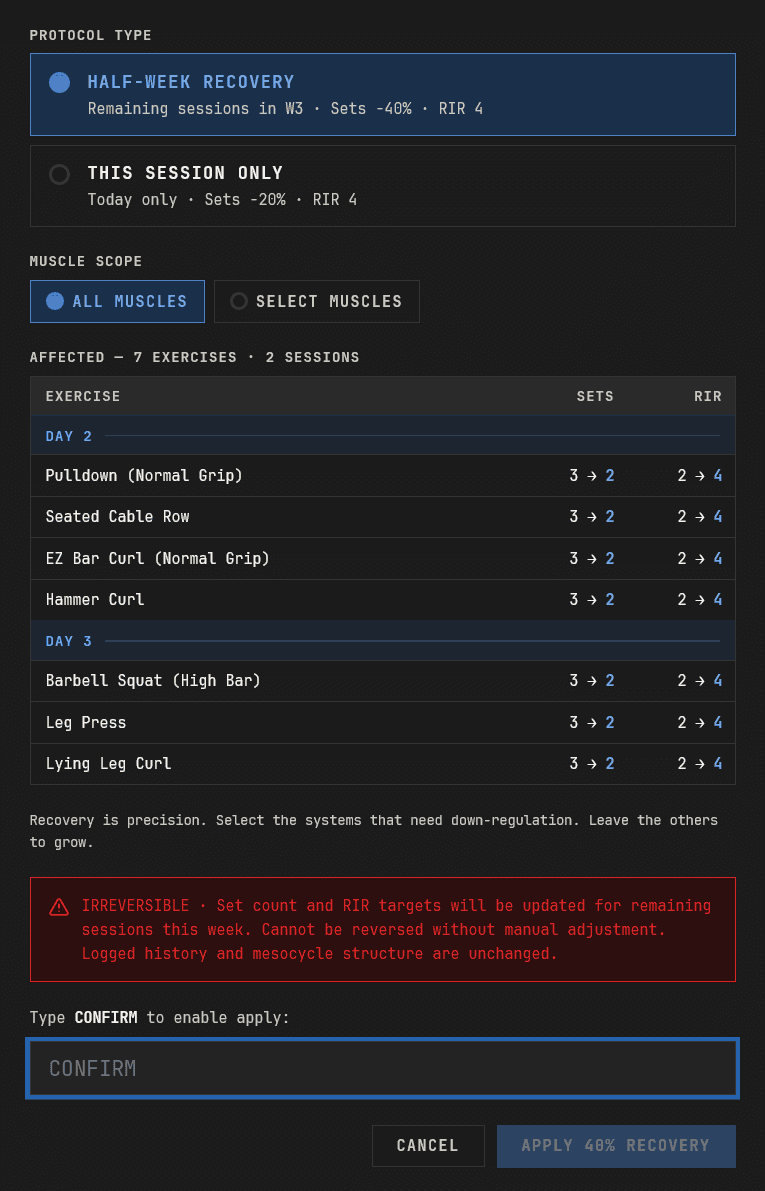
When fatigue changes the call, Calyber can hold or pull back
In the walkthrough above, some work pushes and some holds. When the signal is fatigue, the same engine can reduce stress instead of ending the whole block.
- EXERCISE
- HALF WEEK
- SESSION
Advanced detail
The walkthrough above is enough to understand the loop. Open these if you want the mechanical details.
▸See how a block is plannedproof block
Programs are configured per mesocycle: weeks, days, muscle priorities, and the RIR progression schedule. The builder generates the full week-by-week structure with planned exercises, set counts, rep ranges, and target RIR per session.
Methodology →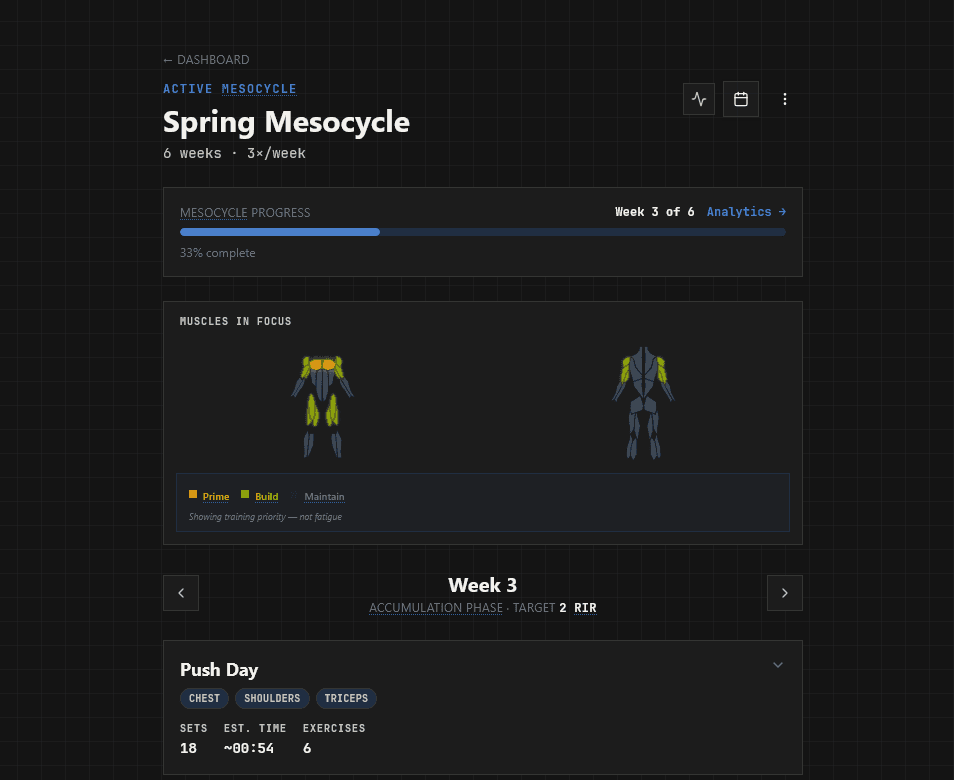
MESOCYCLE BUILDER · Upper Body - 2026
- Length
- 13 weeks
- Days / week
- 5
- Exercises
- 26
- Total sets planned
- 1119
▸See the logging referenceproof block
Logging is the input layer for everything downstream. Weight, reps, completion state, and notes are recorded per set. Auto-progression suggests the next session's weight and rep targets from prior performance.
e1RM formula →SET-BY-SET LOGGING · Upper Body - 2026
- Sets logged
- 1,068
- Sets skipped
- 51
- Compliance
- 95%
- Weeks logged
- 13 / 13
▸See the fatigue index (MGFI)formula reference
The Muscle Group Fatigue Index is a composite of soreness, pump, workload, and performance, split into a Readiness Index (short window) and an Accumulation Index (decayed multi-session burden). The fatigue map renders per-muscle state so you can see which groups are fresh, building, elevated, or critical before training them.
Fatigue Index reference →FATIGUE MAP · MGFI
- Composite inputs
- 4 signals
- Decomposition
- RI + AI
- Update frequency
- Per session
- Muscle groups tracked
- All trained
▸See the autoregulation event log (34 events)proof block
Algorithm interventions across 13 weeks of Upper Body - 2026
▸See the recovery protocolsreference
A deload is a load reduction, not a rest week: volume drops, movement continues. Per-exercise adjustments fire when a single movement spikes fatigue; half-week and whole-session recovery commands run when subjective inputs exceed sustainable ranges. Recovery runs alongside the prescription engine, not as a manual override.
Recovery Protocol →RECOVERY PROTOCOLS
- Planned deload weeks
- W13
- RIR @ deload
- Target ≥ 4
- Trigger basis
- MGFI threshold
- Adjustment scopes
- Per-exercise · half-week · session
Try the full loop on your own training.
Build a block, log real sessions, and see more of the block turn into muscle.
28-day free trial · No card required
Trial starts when you build your first mesocycle
Founding $19/mo locked · Standard $29See plans →