One schedule for everything.
- Quads
- Chest
- Back
- Shoulders
- Triggered by the calendar, not your data.
- Every muscle pulls back at once.
- Recovered lifts lose a week they did not need.
- Fatigue is treated as one global number.
Calyber eases the one muscle that is under-recovered and keeps the muscles that are still ready progressing, so recovery does not cost you a week of growth.
315 x 4, target missed
Readiness below threshold, second session
225 x 8, on target
Performance stable
30 x 12, setup varied
Low benchmark reliability
Example: one session, three different calls.
A fixed deload reduces stress for the whole body on a schedule. That helps when fatigue is global. It cuts productive training short when only one muscle group, one lift, or one session needed a temporary reduction.
One schedule for everything.
A response scaled to what is fatigued.
Fixed deloads are blunt because fatigue is local, not global. Autoregulation treats recovery as a ruleset, not a fixed date.
Calyber does not ask you to guess whether you feel recovered. It uses logged performance, fatigue signals, workload, and recovery context to decide whether training should keep progressing, pull back locally, or enter a stronger deload state.
Each session runs the same checks, in order. One missed session is not a reset.
Performance below the readiness threshold?
Continue progression
Monitor the next exposure
Did the same readiness problem repeat next session?
Do not overreact
Suggest reactive deload
Reactive deload is suggested when two consecutive sessions both fall below the readiness threshold, not when you simply feel tired.
The response scales with how far fatigue has spread, and how long it has persisted.
A stronger reset after two sessions below the readiness threshold.
The lightest touch. Trims unlogged work for today only.
Eases the rest of the week while the block stays intact.
Targets one muscle group on its next session.
The planned lighter week built into the block.
| Protocol | Sets | RIR target | Scope |
|---|---|---|---|
| Session-only recovery | Sets reduced 20% | RIR target 4 | Unlogged exercises today only |
| Half-week recovery | Sets reduced 40% | RIR target 4 | Remaining sessions this week |
| Muscle-specific recovery | Sets reduced 40% | RIR target 4 | One muscle group, next session |
| Reactive deload (mid-cycle) | Sets reduced 50% | RIR target 6 | Remaining week or scheduled next week |
| Scheduled deload week | Load capped near 50% of peak | RIR target 8 | The planned deload week |
| Protocol | Sets | RIR target | Scope |
|---|---|---|---|
| Session-only recovery | Sets reduced 20% | RIR target 4 | Unlogged exercises today only |
| Half-week recovery | Sets reduced 40% | RIR target 4 | Remaining sessions this week |
| Muscle-specific recovery | Sets reduced 40% | RIR target 4 | One muscle group, next session |
| Reactive deload (mid-cycle) | Sets reduced 50% | RIR target 6 | Remaining week or scheduled next week |
| Scheduled deload week | Load capped near 50% of peak | RIR target 8 | The planned deload week |
Calyber shows the scope, affected exercises, set changes, and RIR changes before the protocol is confirmed. Recovery is not hidden. You can see what is being adjusted before you accept it.
Recovery changes are applied deliberately and require confirmation inside the app.
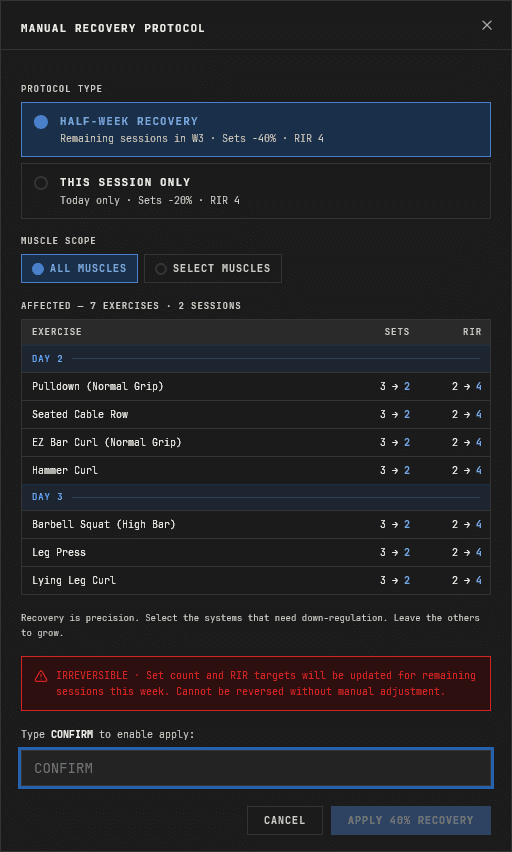 12345
12345When one muscle group is under-recovered, Calyber can reduce stress there while keeping productive training moving elsewhere.
That means recovery does not have to feel like losing a week. You can pull back where the signal is clear, keep training where performance is still stable, and stay inside the rhythm of the block.
Example flow. The same session produces a different decision per lift.
Readiness low, two sessions running
Sets reduce, RIR target rises on the next quad session.
Performance on target, fatigue stable
The prescription holds its planned progression.
e1RM trend up, fatigue low
Load steps up on the next session.
A full deload should not be the only tool between keep pushing and block ruined.
Logged sets
Load, reps, and RIR from each set.
Fatigue signals
Readiness and accumulation, per muscle.
Recovery protocol
The scoped response when a threshold is crossed.
Next prescription
Sets and RIR for the following session.
Block review
What moved, what stalled, what changed.
Each step feeds the next. Recovery is part of the loop, not a pause in it.
If quads are cooked, chest training does not need to die with them. Recovery stays local, temporary, and tied to the data instead of forcing every muscle into one call.
Train hard where you are ready. Recover where the data says it is time.
No card required. Begin with a 28-day calibration block.